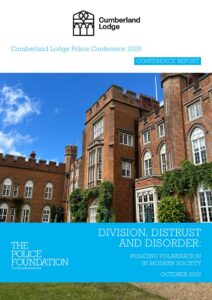
If policing is to maintain its legitimacy as a keeper of the peace, it must confront difficult questions about its role in an increasingly polarised society. What does it mean to uphold the law without fear or favour when public consensus is so fractured? How should officers respond when political, cultural and social conflicts increasingly play out in the streets they are asked to police? How can the police maintain public confidence when trust in institutions is declining more broadly? And how can they communicate a single, strong message to citizens increasingly splintering off into their own tribes with their own personal echo chambers? Yet these questions are almost impossible to answer amid the demands of day-to-day policing. The 44th annual Cumberland Lodge Police Conference, titled ‘Division, Distrust and Disorder: Policing Polarisation in Modern Societies’, gave police leaders, academics, policymakers, practitioners and politicians from all sides of the political spectrum a rare opportunity to step back and reflect on what may be required to maintain legitimacy, restore public confidence and reinforce social cohesion in the years ahead.